

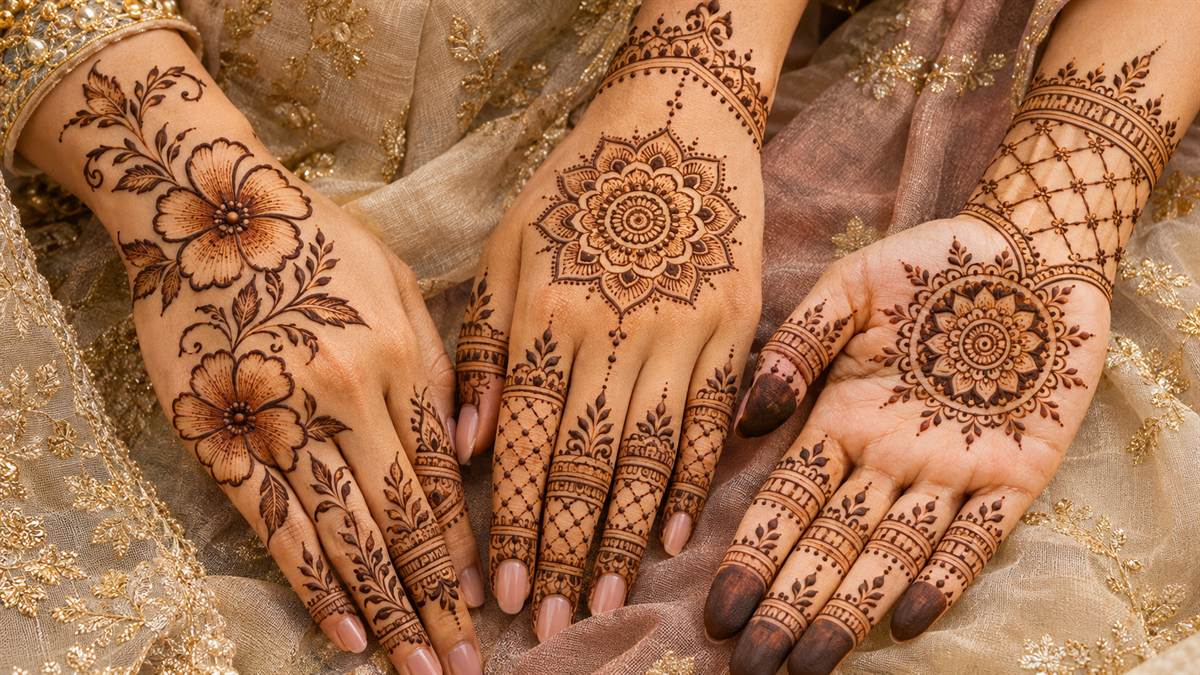
A search for mehndi design ideas often returns long galleries with little help choosing a pattern. A design that looks striking across a full palm may not suit someone who wants a small wrist detail. Think about placement and scale before deciding whether the pattern should be floral, geometric, or highly detailed.
Twelve pattern directions to sketch or discuss
| Placement | Idea | How to make it distinct |
|---|---|---|
| Palm | Single central circle | Build petals or geometric rings around one focal point; leave the outer palm open. |
| Palm | Off-center flower | Place the largest bloom toward the thumb and let small leaves follow the hand’s curve. |
| Palm | Diagonal vine | Run one stem from the wrist toward a finger rather than filling the whole palm. |
| Palm | Split composition | Put detail on one side and preserve a clean gap through the center. |
| Back of hand | Wrist-to-finger trail | Connect a small wrist motif to one finger with a thin line of leaves or dots. |
| Back of hand | Knuckle band | Repeat a compact shape across the knuckles without covering the entire hand. |
| Back of hand | Open lattice | Use a loose grid with small accents at intersections and generous negative space. |
| Back of hand | One-sided border | Follow the outside edge of the hand with flowers or simple scallops. |
| Fingers and wrist | Finger caps | Concentrate pattern near the fingertips, leaving the lower fingers bare. |
| Fingers and wrist | Alternating finger motifs | Use one repeated element on selected fingers so the design does not become crowded. |
| Fingers and wrist | Bracelet band | Wrap a narrow repeat around the wrist, with one focal motif on top. |
| Fingers and wrist | Small standalone symbol | Place a simple flower, leaf, or geometric mark where it remains visible on its own. |
These are composition ideas, not claims that each motif belongs to a particular regional tradition. If a design has cultural or family meaning, ask the person whose tradition you are drawing from about the motif rather than assigning it a meaning from a generic image search.
Choose density and line size
For a small design, use fewer shapes and slightly bolder lines so the main motif stays legible. A full-hand pattern can carry finer detail, but it still needs visual rests. Compare two sketches at the size they will actually occupy on the hand. If a small motif looks like a dark patch, remove detail before adding another border.
Bring a clear brief to the artist
A useful brief might say: “Back of the right hand, from wrist to middle finger; one floral focal point; open space around the knuckles; no dense fill on the palm.” Add a photo of your own hand or a simple outline to show placement. Reference images can help communicate scale, but do not ask an artist to reproduce someone else’s design exactly without permission.
Check what will be applied to the skin
Ask what is in the paste before application. The US FDA warns that products marketed as “black henna” may contain p-phenylenediamine (PPD), which can cause serious skin reactions; it has also received reports of reactions to other products marketed as henna. A “natural” label or a quick patch test is not a guarantee of safety. If you have a history of reactions or develop symptoms, seek advice from a qualified clinician.
The right design is one you can describe in terms of placement, motif, and density. That gives an artist room to make a coherent pattern for your hand instead of copying a gallery image that was made for someone else.
