
6 Photoshop Actions

Aperture and/or other technological photography fundamentals can cause yawns in most of the keen growing shutterbugs, however, once if these essentials or the basics are understood by them, the remaining photography can be easily focused on. All the terms, Aperture, ISO and shutter speed can be followed, if you have cameras of point and shoot or a professional one. This article will be a great help and will explain aperture and will definitely provide tips for using this type of camera for a better photography creation.

For a better understanding of aperture, you should fist think about the bigger and smaller growth of the irises of eyes when more/less light enters the pupil. Likewise, the lens of the camera diaphragm narrows and broadens for letting in light more or less. Therefore, it is aperture that determines the picture exposure and that results in clear or dark photographs. Apart from this aperture also has other vital function which will be explained further in the article.

“Aperture” means the size of opening and is usually F stops measured. If the F stop is smaller, the aperture will be wider. This may be quite confusing. Therefore, ratios are regarded as F stop numbers and that is why if the F stop number is big, the aperture size will be small.
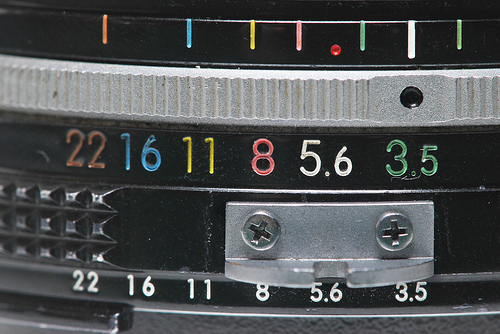
Coloured aperture values. Photo by Steven Wong

Depth of the field is also controlled by the aperture along with the light control. This theory can be better understood by holding a fist in front of the eye and when u open your hand slowly, you can see the changing focus. And if the fist is opened larger, more you can see. Thus, you can notice that initially when the fist was small, things which you could see were equally focused. If you try again, you can notice that when the fist is opened, the closest object is focused sharply whereas, the far away objects are out of focus. Same thing is explained in the field depth of aperture and it determines the focused photographs.

Pictures taken in Auto Focus (AF), the camera attempts to focus the main subject, but actual it may not when you really want it. For this main reason, most of the cameras are set with Aperture Priority setting to eradicate this difficulty. By doing this setting, the speed of shutter gets adjusted to balance aperture that is larger/smaller aperture. For instance, if a landscape aperture is set, the shutter narrows and less brightness gets in. Therefore, the camera lengthens automatically and the shutter continues to be open so that the photo does not get underexposed. Though the priority of aperture is not perfect, normally it do work.

If you own a SLR and pictures are taken while in manual mode, shutter speed and the aperture can be adjusted separately. Many people have cameras which are in the present modes, like, sports, landscape, portrait etc. And if the mode is set in the landscape mode, automatically aperture narrows so that everything is focused. Simultaneously, the speed of shutter is automatically adjusted or slows down and leaves the shutter open for a longer time and is offset for small amount of light that is coming all through the diaphragm of lens.

Dramatic Effect with False HDR - Photoshop Action

And if you go in portrait mode and try to focus on a person or thing that is in your front with landscape background, the camera brings the subject in focus and makes the standing person come out more clearly against landscape. Therefore, shutter speeds up so as that the picture is not overexposed by more light that is allowed in the aperture that is large.

Ricoh 55 mm prime lens. Nice pentagonal aperture and colored reflections from the glass.

You should always remember that if the aperture is small, the F stop number is great (as a single ratio is represented and not the number in whole) and the field dept is also great. Usually photo shooting modes are supported by digital cameras that are automatic and you have manually just point and shoot where the cameras do not do anything. Aperture Priority is one of those modes. It is useful in various situations and is worthy of an explanation of its use and type.

When you set the camera in an Aperture priority mode by using the menus that are on the camera LCD, you have to look through and choose from the menus which Aperture priority you want by just rotating dial modes and choose the aperture priority according to its symbol, which in most of the cases are “A” (capital A).

In this mode you have set the aperture value manually and for the rest of the thing, camera takes care. For instance, the optimal speed of the shutter is set according to your choice of aperture. Though certain physical limitations are there and all the chosen aperture value cannot be matched with other settings that can result in a better photo. The camera itself will tell you by flashing a LED that is green in color or in other cases; you can just check them manually.

So, there is nothing to bother about manually setting the aperture value when there is a camera all set and ready to shoot at your service. Field depth can be defined as a range where the photo is focused. For instance, an infinite field depth is meant a photo that is in focus and is within an assured distance from camera to infinity. A narrow or shallow field depth means that photo that is in focus only from a certain camera distance to other distance that isn’t far away. Therefore, the remaining objects are not in the focus and appear blurred.

When the aperture value is wide there is decrease in F number and if the field depth is narrow/shallow or vice versa: there is increase in the F number if the aperture value narrows along with the deeper field depth. You have to always remember that field depth changes according to the F number, therefore, then there is increase in F number, the field depth increases and same is common if the F number decreases. You can manually control the aperture value and achieve a narrow field depth while taking a portrait photo or when you want a blur background that is behind the portrait object.

It is always advisable to experiment for understanding the aperture settings. By doing this you can easily get the translated aperture values and the field depth. It is very important to know field depth which not only depends upon the aperture value but also the distance of the object from the lenses and the camera used. As there is free experimenting with the digital camera you can easily review your photos instantly as there is no cost for development of film.

There are several options that digital cameras provide exposure control. And it is essential to know the correct usage of these cameras for best photography results. At an earlier times SLR cameras/film were manually operated. A photographer should understand the settings of aperture and shutter speed and its usage. Then afterwards automatic modes came into existence where the camera did all the things. This was regarded and still regarded as a very good reliable method of getting good quality pictures, but as the camera did all the things, the photographer’s creativity was lost. As time passed by, a small number of people studied the manual skills. And as the technology of camera improved, the photo quality actually got worsened.

In today’s world we have the best cameras and all the DSLR cameras and the compact digital cameras are of manual as well as automatic modes, but there are some semi-automatic modes too. Which means you can also be creative as well as have the controlled camera for exposure. If you own a camera that is Aperture and Shutter Priority, but you never understood what use is there, this is the right article for your information regarding this.

Firstly, you must know what is Aperture and Shutter Speed?

It can be explained as two mechanisms that is used for controlling the photo exposure level, such as, if photo will be underexposed, overexposed, , or is just correct. To explain these terms properly, you have to just go through the article and below are the quick summary about these terms.

Carl Zeiss Lens

In simple terms, the whole size by which the light is passed through your camera is an Aperture. You can think them as your eye iris, as there is lower light, the aperture is opened so that more light can come in. The field depth is also controlled by the Aperture that usually affects the picture focus. If the aperture is small, the field depth is large and so are the surroundings and subjects that are focused. And wider the aperture, the field depth small, so therefore, the surroundings and subject focused will be less.

The speed of shutter depends on the time length of the exposure. The shutter should open and allow the passage of light; therefore, if the shutter is opened for a longer time, the exposure is brighter. Photo capture movement is also controlled by the Shutter speed. For example, if you want to a moving subject to freeze, you have to use the shutter speed faster. The main trick of combining the aperture and shutter speed settings is for best result. If the balance is right, your photo is exposed perfectly, and you have a creative control over the image look.

To manage you have the option of Aperture and Shutter. The semi-automatic models allow controlling the setting, and the other settings are done automatically by the cameras. This allows having some of your creativity that you can input. With the help of safety net the camera takes care of exposure level. Here you have to decide the quality and look of the photo and the camera will automatically adjust itself for correct exposure.

So, now it’s your choice: whether to choose Shutter or Aperture Priority.

You should always keep in mind that the field depth is controlled by the aperture. So, if you give preference to focus range, you can choose aperture priority. The camera can adjust if you want a smaller aperture to maximize the field depth, or a larger aperture to focus concentrates the subject.

The movement of the photo is controlled by the Shutter speed. To control a subject that is moving, you can choose the shutter priority. This will definitely allow you to set a faster shutter speed if you want a moving subject to freeze or setting a slow shutter speed for capturing a blurred motion. The camera will take care if you choose any of the so that your photo is exposed correctly.

So, it depends on your shooting whether you want Aperture Priority or Shutter Priority, and how do you want your final photograph to look. It is an ideal marriage of technology and art where you have to concentrate on your creativity more than technical matters. There are many things that you can learn on this topic/matter and a small article is not enough to throw more light on this topic and is just an initiation of this topic. However, reading the camera manual can be a quick reference and guidance can help a lot to understand about the Aperture and Shutter priority.